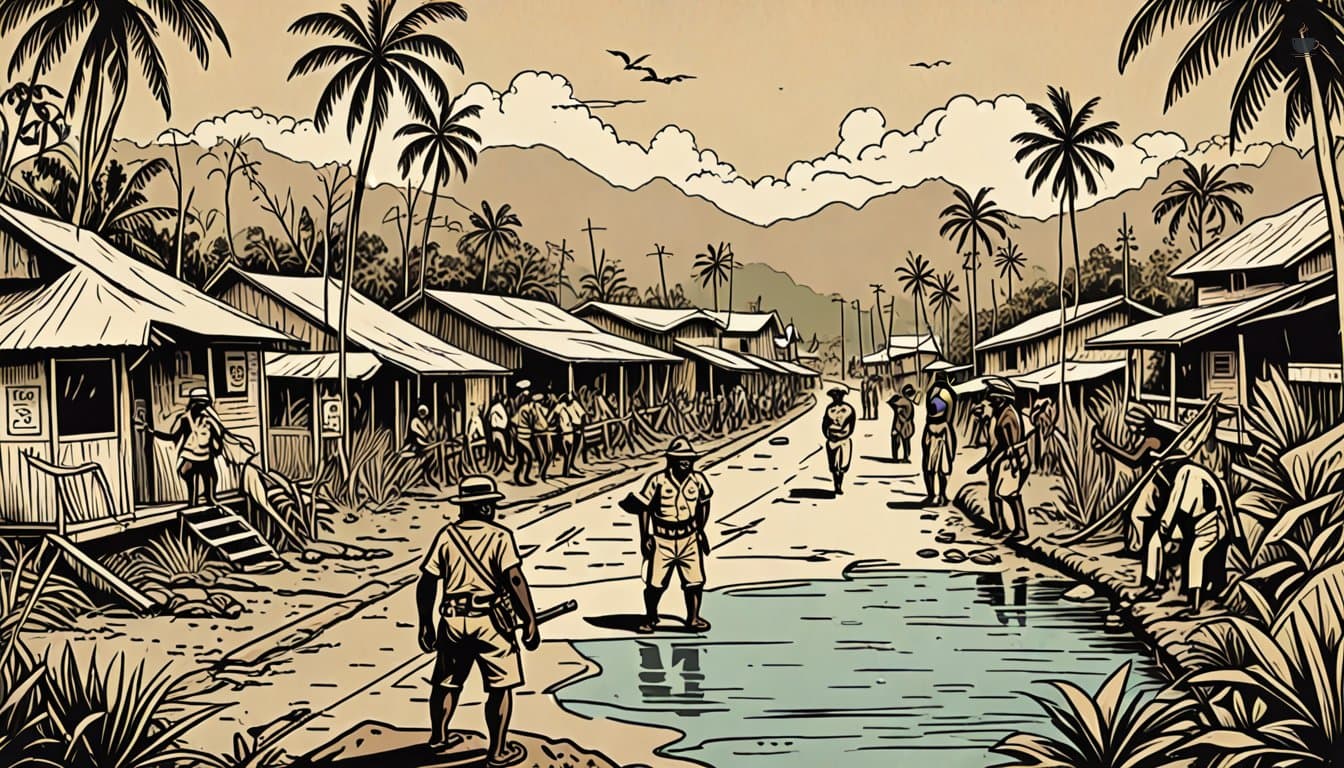
Papua New Guinea Grapples with Escalating Violence and Law Enforcement Challenges
Violence spreads through islands
Order slips away
Papua New Guinea (PNG) is facing a critical juncture as violence and law and order issues continue to escalate across the nation, posing significant challenges to public safety and governance [1][2]. Recent incidents highlight the spread of unrest beyond traditional conflict zones, signaling a worrying trend for the Pacific island nation.
In a shocking incident in Hela province, a mother of six fell victim to a horrific act of violence, shot after being tortured and burned due to accusations of sorcery [1][2]. This tragedy underscores the persistent issue of sorcery-related violence in PNG, a problem that continues to plague rural communities despite efforts to combat such beliefs.
The capital, Port Moresby, has not been spared from the rising tide of violence. Recently, bus drivers retaliated following the killing of a colleague in the suburb of Hanuabada, prompting National Capital District Governor Powes Parkop to plead for calm and urge citizens not to take the law into their own hands [1][2]. This incident highlights the fragile state of law and order in urban areas and the potential for violence to escalate rapidly.
Paul Barker, Executive Director of the PNG Institute of National Affairs, in an interview with RNZ Pacific, expressed concern over the expanding reach of violence: "We're certainly having law and order problems that have in the past tended to be restricted to certain provinces and locations seem to have extended to additional provinces that were hitherto relatively peaceful, including East New Britain" [1][2].
The root causes of this escalating violence are complex and multifaceted. Economic frustrations, weak rule of law, and the involvement of power brokers and illicit trades all contribute to the current crisis [1][2]. These factors create a volatile environment where violence can easily ignite and spread.
Efforts to address these issues are underway, but face significant challenges. The importance of effective policing and community cooperation has been emphasized as crucial in tackling the violence [1][2]. However, the police force itself has been a source of instability, as evidenced by a police strike last year that sparked a calamitous riot in Port Moresby [1][2].
International assistance is increasingly seen as necessary to address PNG's law and order issues. Barker suggests that "PNG will need international assistance to address the law and order issues in the country" [2]. This call for external support underscores the severity of the situation and the need for a coordinated, multi-faceted approach to restore stability.
In a related development, PNG is strengthening its defense cooperation with neighboring Indonesia. Defense Minister Billy M. Joseph met with his Indonesian counterpart, Sjafrie Sjamsoeddin, in Port Moresby on July 7, 2025, resulting in agreements to bolster defense cooperation [3]. While not directly addressing internal violence, this move could potentially contribute to improved border management and regional stability.
As Papua New Guinea grapples with these escalating challenges, the need for effective policing, community engagement, and international support has never been more critical. The coming months will be crucial in determining whether the nation can reverse the tide of violence and restore law and order across its diverse landscapes.